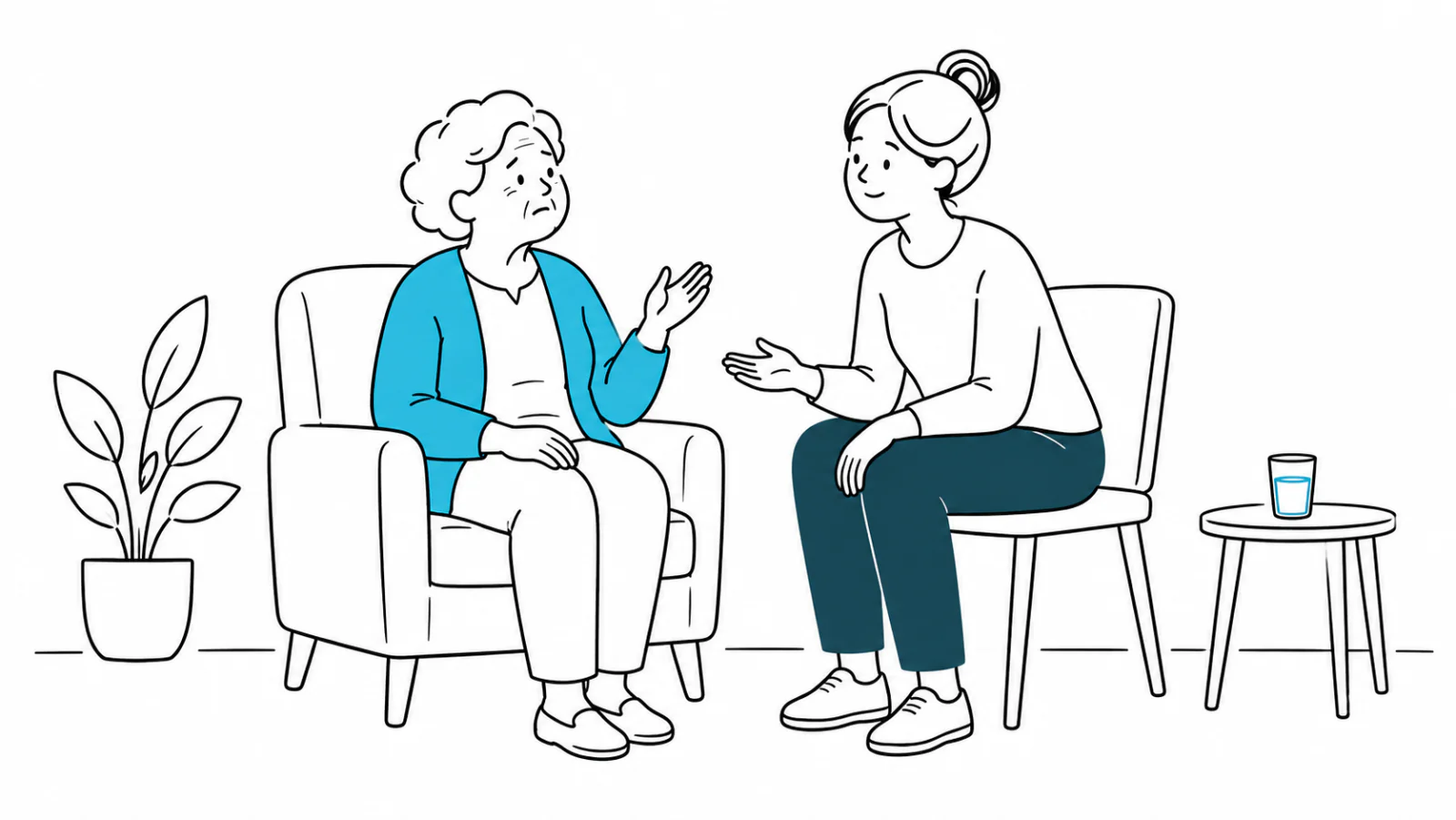
People with dementia may display behaviours such as agitation, irritability, resistance to care or aggression. These behaviours usually have underlying causes such as pain, disorientation, unmet basic needs, changes in routine, excessive stimulation or an inability to make sense of the surrounding environment. Urinary and respiratory infections or metabolic changes may also suddenly worsen confusion and agitation.
Identifying the cause – Before considering the use of medication, assess possible triggering factors, identifying patterns of timing or context.
Learning how to communicate – Listen carefully to what the person expresses, and try to understand the reality they are experiencing, in order to grasp the underlying emotions. Validate their experiences with simple phrases such as “I understand that you are upset”, which may ease the situation and prevent the conflict from escalating.
Redirecting and preventing – Divert their attention, channelling it towards simple and meaningful activities connected to their life story, such as folding clothes, peeling vegetables or organising objects. Even if the tasks are not carried out perfectly, they provide a sense of purpose and participation.
Ensuring your safety – The safety of the caregiver is the priority. In moments of greater agitation it is important to keep some distance, avoiding becoming cornered or turning your back, as well as removing potentially dangerous objects from reach.
Anxiety, agitation and repetitive behaviour
Predictable routines, exposure to morning light, gentle physical activity and visual aids can help ease disorientation and restlessness.
Learn more
Changes in perception and judgement of reality
It is important to offer reassurance, acknowledging emotions and avoiding arguments or contradicting mistaken perceptions.
Learn more
Apathy
Routines and simple activities help encourage participation. Recognising small steps forward strengthens self-esteem and motivation.
Learn more
How to help
Anxiety, agitation and repetitive behaviour
Psychomotor agitation may manifest as constant restlessness, repetitive handling of objects or prolonged wandering. These behaviours represent attempts to ease anxiety, creating a sense of security and predictability.
Understanding the meaning
Restlessness may be related to memory loss, disorientation or difficulty in expressing needs. The person may have difficulty recognising their own home or may wish to resume former routines and social roles, such as leaving home to go to work. These behaviours tend to intensify at the end of the day, a phenomenon known as sundowning, associated with changes in the sleep–wake rhythm.
Adjusting the environment
Exposure to light during the day and moderate physical activity, preferably in the morning, help regulate the circadian rhythm, the body’s internal biological clock responsible for controlling various physiological functions, including sleep-wake cycle.
At the end of the day it is preferable to favour a calm environment, with reduced noise and intense lights. It is also worth avoiding caffeine and sugar.
Responding to repetition
Repeated questions or actions often result from the inability to recall recent information and may reflect an underlying concern or the need for reassurance. In these situations, respond with calm, patience and consistency, as showing frustration tends to worsen the situation.
Providing orientation aids
Easy-to-read clocks, visible calendars, boards showing the daily routine or labelled photographs help the person to orient themselves in time and space, and although they do not eliminate the behaviour, they may help to reduce the associated anxiety.
How to help
Changes in perception and judgement of reality
Some people with dementia may present changes in perception or persistent beliefs that influence the way they interpret the world around them. These experiences, although they do not correspond to observable reality, are real to those who experience them and may give rise to fear, anxiety and defensive behaviours.
Differentiating and assessing causes
Hallucinations correspond to sensory perceptions without a real stimulus, and may be visual (seeing people), auditory (hearing voices), olfactory, tactile or gustatory. Illusions are distortions of existing stimuli. Delusions, in turn, are persistent beliefs that do not yield to logical explanations, with ideas of theft, persecution, jealousy or abandonment being common.
Adressing the emotion
Arguing or trying to disprove incorrect perceptions or beliefs and systematically contradicting what the person believes tends to increase anxiety and distrust, generates frustration and discourages them from sharing their feelings again. Acknowledge the emotion and convey physical and emotional security, expressing empathy for what they are experiencing.
Adjusting the environment
Well-lit environments reduce mistaken interpretations. Shadows and dim light, mirrors, the television switched on or decorative objects may be mistaken for people or movements. Also ensure the appropriate use of glasses and hearing aids.
Knowing when to seek help
If the symptoms appear suddenly, cause significant distress or involve risk, medical assessment may be necessary to identify any reversible causes and, if needed, adjust treatment.
Apathy is characterised by a reduction in interest, initiative and emotional expression. There may be a loss of interest in previously enjoyed activities, as well as in decision-making. This behaviour is a manifestation of the brain changes that affect the circuits of motivation and reward processing. Unlike depression, apathy does not necessarily involve sadness, but rather indifference, reduced emotional involvement, and a consequent detachment from the surroundings.
Structuring the day
Predictable routines and stimulating environments offering meaningful activities help to reduce inactivity and apathy.
Proposing concrete activities
Instead of asking what the person wants to do, suggest simple and specific tasks, with clear objectives and short duration.
Valuing small progress
Recognising each effort reinforces self-esteem and the feeling of usefulness, so even if they seem indifferent, the person benefits from attention and affectionate encouragement.