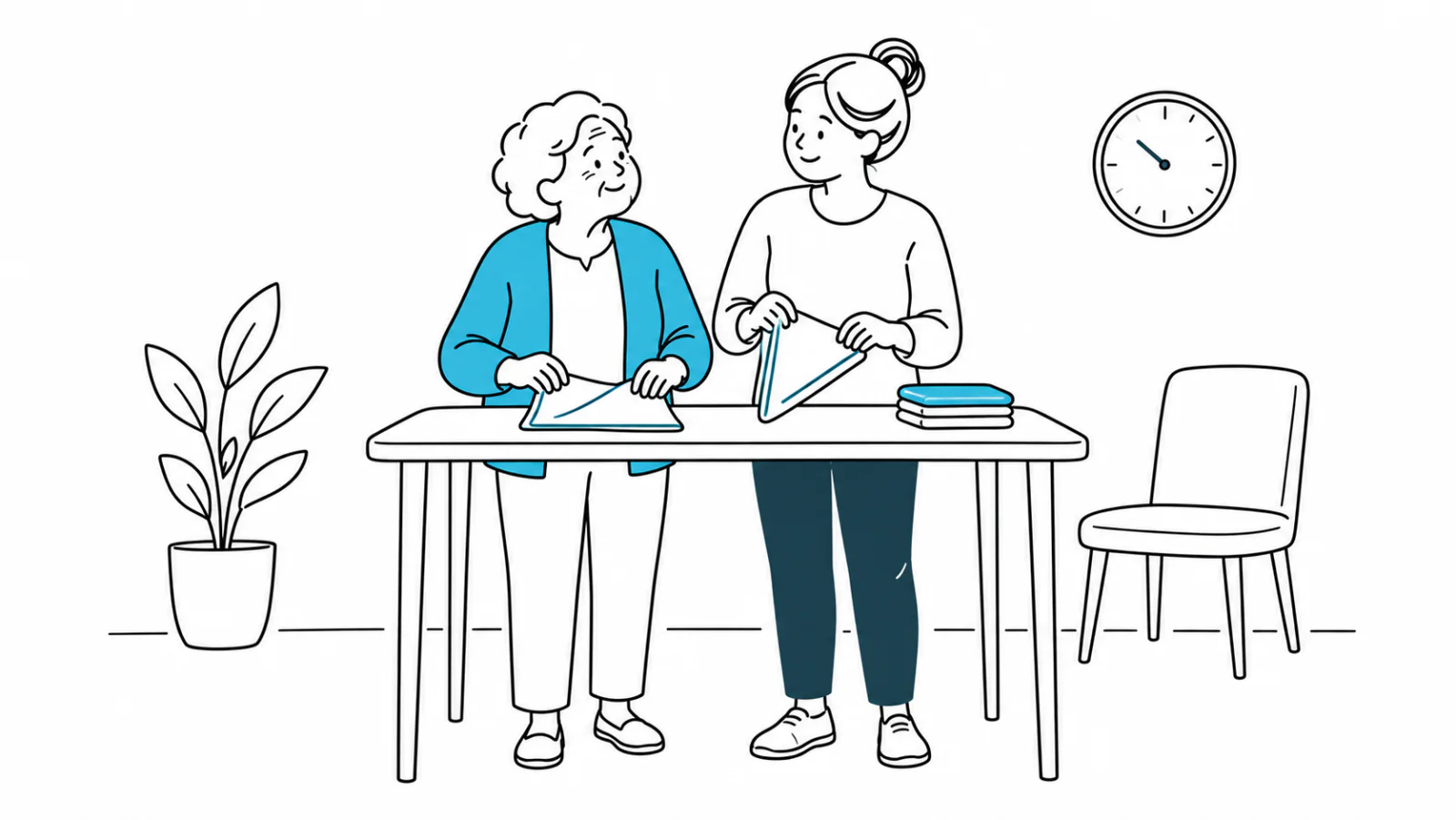
Dementia causes progressive changes in memory, behaviour, communication and functional ability. These changes affect everyday life and require constant adaptation. Many behaviours that appear to be intentional result from difficulties in communicating discomfort and from a failure to understand environmental cues. Understanding this basis is essential in order to respond more effectively, reduce conflict and preserve dignity.
The aim of these strategies is to share practical guidance that promotes safety, well-being and quality of life. Each caregiver should assess what makes the most sense for them, trying to understand the reasons that may trigger certain behaviours.
Regardless of the specific situation, some guidelines apply across the board. Simple, clear communication is preferable, giving one instruction at a time; furthermore, tone of voice, posture and facial expression have a significant impact and are often more important than the words themselves.
Emotional validation brings more benefits than confrontation.
Agreeing is more beneficial than contradicting. Even when the person's interpretation of reality does not match the facts, they are experiencing a genuine emotion.
Maintaining predictable routines reduces anxiety and disorientation and promotes behavioural stability, which is why organised environments without excessive stimulation are preferable.
Finally, whenever possible, autonomy should be prioritised, doing things with the person rather than for them: safety is essential, but it must always be balanced with respect for personal freedom and identity.
Bibliographic references
Mainly referring to the pages Caregiving: General Strategies I Behavior Changes I Facilitating Communication I Environments and Routines I Being a Caregiver I Caregiver Self-care I
Alzheimer's Association. (n.d.). Behaviors: How to respond when dementia causes unpredictable behaviors [PDF]. https://www.alz.org/getmedia/9261e8ad-3413-49c4-bd9e 7689a7deb15f/alzheimers-dementia-behaviors-ts.pdf
Alzheimer's Society. (2021, July). Changes in behaviour (Factsheet 525LP). https://www.alzheimers.org.uk/sites/default/files/pdf/changes_in_behaviour.pdf
Comissão Europeia & Alzheimer Europe. (1999). Manual do cuidador. APFADA.
Comissão Europeia & Alzheimer Europe. (2006). Manual do cuidador. APFADA.
Hay, J. (2008). Doença de Alzheimer e Demência. Plátano Editora.
Humber NHS Foundation Trust. (2012). Pathway for the assessment and management of behavioural and psychological symptoms of dementia (BPSD) (Version 1.01). https://www.hey.nhs.uk/wp/wp-content/uploads/2016/03/bpsdPathway.pdf
Lindeza, P., Rodrigues, M., Costa, J., Guerreiro, M., & Rosa, M. M. (2020) Impact of dementia on informal care: a systematic review of family caregivers’ perceptions BMJ Supportive & Palliative Care 2024;14:e38–e49. doi:10.1136/bmjspcare-2020-002242
National Institute of Aging (2026, July 13). Alzheimer's Caregiving: Home Safety Tips. https://www.nia.nih.gov/health/home-safety-checklist-alzheimers-disease.
Nunes, B. (2014) Alzheimer em 50 questões essenciais. Lidel.
O vestuário dos idosos. (2026, July 13). http://normashigiene.blogspot.com/2008/11/vesturio vestir-e-despir-idosos.html
Portal do Idoso (2026, July, 13). 10 Adaptações Simples para Evitar Acidentes Domésticos. https://idosos.com.br/adaptacoes-de-ambientes
Sérgio, J. & Valença, A. (2003). Alguns conselhos sobre a doença de Alzheimer. APFADA.
Sociedad Española de Geriatría y Gerontología. Grupo de Calidad. (2025). 25 recomendaciones de calidad en atención centrada a personas que viven con demencia y a sus familias. Sociedad Española de Geriatría y Gerontología. https://www.segg.es/media/descargas/25-recomendaciones-de-calidad-en-atencion centrada-a-personas-que-viven-con-demencia-y-a-sus-familias-GT-Calidad-SEGG.pdf
Sociedad Española de Geriatría y Gerontología. (2026). Manual de competências para cuidadores de pessoas idosas em situação de dependência (ed. portuguesa; M. A. García Antón, Coord.; revisão da edição portuguesa por M. J. Quintela & J. Ferreira Alves). Sociedad Española de Geriatría y Gerontología. manual-competencias-para-cuidadores-de-idosos-dependentes-2026.pdf